How to spot charity fraud: common scams, red flags and what to do if you paid
On this page9 sections
Charity fraud is collecting donations for an organization that does little or no charitable work, or impersonating a real charity to divert gifts. Most scams share three traits: pressure to give now, a name that imitates a known charity, and a request for untraceable payment. If you already paid, contact your bank immediately and report it.
In short
- Charity fraud ranges from fake charities to impersonating real ones and misusing donated funds.
- Scams spike after disasters and arrive by phone, text, email, social media, crowdfunding and street collections.
- The tells are in the request: pressure, untraceable payment, copycat names and vague claims.
- If you paid, call your bank first, watch your statements and expect a possible second scam offering to recover your money.
- Report it to your national fraud or consumer authority and the charity regulator.
What counts as charity fraud
Charity fraud covers fake charities that do little or no charitable work, scammers who impersonate a genuine charity, and the misuse of funds raised for a legitimate cause. It is especially common after high-profile disasters, when people want to help quickly.
The simplest form is an organization that exists only to collect money, which then goes to whoever set it up (FBI). With impersonation, a fraudster uses the name of a real, often well-known charity (Report Fraud). The third form, usually called nonprofit fraud, happens inside an organization, when money raised for a genuine cause is diverted (Report Fraud). This guide focuses on the first two, the scams aimed at donors.
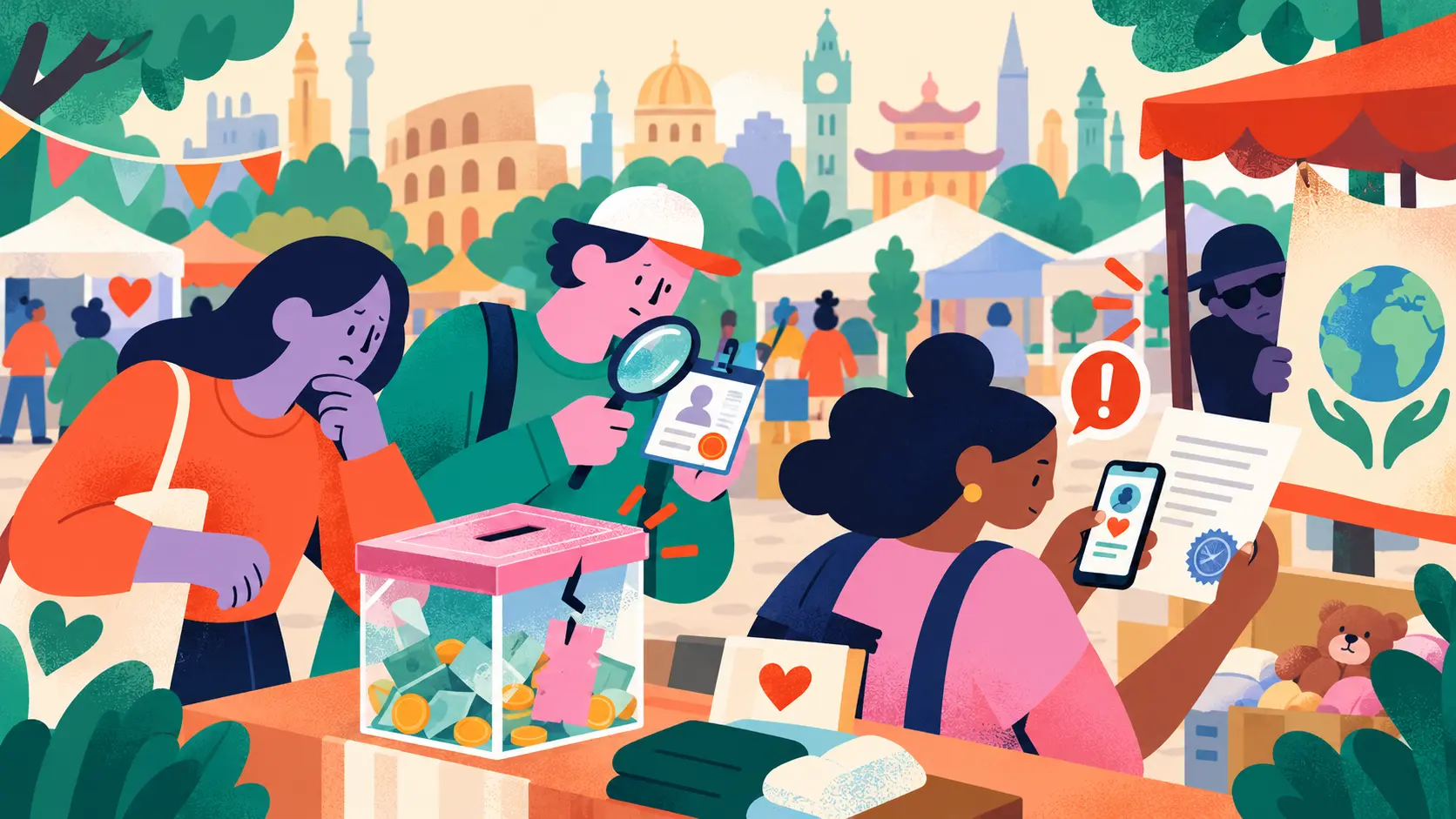
Requests reach you through emails, social media posts, crowdfunding platforms and cold calls (FBI), and through street and doorstep collections (Report Fraud).
A charity that is badly run, files late or spends heavily on fundraising is not automatically a fraud. Those are questions about how it is governed, while fraud is about deception.
Six common charity scams and how they work
Most charity scams follow a handful of patterns: pop-up appeals after disasters, copycat names and websites, high-pressure phone fundraising, fake "you already pledged" claims, donation links in unexpected messages, and fake street or doorstep collections. Each has a tell you can check in under a minute.
| Scam | How it works | The tell | What to do |
|---|---|---|---|
| Disaster pop-up | A new organization appears right after a disaster and claims to help the victims | It has no track record from before the disaster | Give to established charities whose work you know (FBI) |
| Copycat name or website | The name or web address closely imitates a well-known charity | One letter or word differs from the real charity | Write the name down, research it, and type the charity's address yourself (FTC) |
| Phone fundraising | A caller asks you to give now, often a paid fundraiser, sometimes a political action committee rather than a charity | The caller cannot give the exact name, website, address, or how much reaches the program | Ask those questions, then contact the charity directly (FTC) |
| "You already pledged" | A caller or letter thanks you for a pledge or gift you never made | You have no record of it | Stop and check your own records first (FTC) |
| Link in a message or crowdfunding page | An unexpected text, email or social post carries a donation link; crowdfunding money goes to the organizer | The link does not lead to the charity's own website | Do not use the link; go to the charity's site yourself (FTC) |
| Street or doorstep collection | A collector asks for cash or bank details on the spot | No proper ID badge, or a collection tin that is not sealed | Ask for ID and never hand over a PIN or password (Report Fraud) |
With phone calls, the rules give you something concrete to test. In the US, charity fundraisers cannot call before 8 a.m. or after 9 p.m., must tell you the charity's name and that they are asking for a donation, and cannot lie about how your donation will be used or how much reaches the programs (FTC). A caller who breaks them may be dishonest. Caller ID is no help either, since scammers can fake it so a call looks local or appears to come from a known organization (FTC).
Red flags in the request itself
You can often spot a scam from how the money is requested, before you research the charity at all. Requests for cash, gift cards, wire transfers, crypto or payment apps, any request for a PIN or password, and pressure to decide on the spot are reasons to stop.
- Untraceable payment. If crypto, a wire transfer, a payment app or a gift card is the only option, it is likely a scam (FTC).
- Security details. A genuine charity never needs your PIN, banking password or card security code (Report Fraud).
- Pressure. Scammers rush you so you cannot check their claims (FTC).
- Vague, emotional claims with no detail on how your money will be used (FTC).
- A guaranteed prize in return for a donation (FTC).
- Unexpected links in texts, emails or posts (FTC).
A common myth: "real charities use .org". The FBI lists it as a sign of a legitimate site (FBI), but .org is an open, unrestricted domain that anyone can register (Public Interest Registry). The domain ending alone proves nothing.
A single red flag does not prove fraud, but it is reason enough to stop and verify before you pay.
Check the charity before you give
Ask for the charity's exact name and registration number and look it up in the official register of the country where it is registered. Contact the charity through the details in that register, not through the message that asked you for money.
- United States. The IRS Tax Exempt Organization Search shows whether gifts are tax deductible, Form 990 returns and revoked exemptions (IRS). Most states also require charities to register with a state regulator (FTC).
- England and Wales. The Charity Commission register shows address, trustees, aims and finances. Charities with income under £5,000 need not register (GOV.UK).
- Australia. Search the ACNC Charity Register and call back on the number published there (ACNC).
In other countries the register may publish very little, so a missing entry is not always proof of fraud. For those, see how to check if a charity is legitimate in any country.
What to do if you already paid
Contact your bank or card issuer as soon as possible, because they can help stop further losses. Then watch your statements, protect your identity if you shared personal details, and be wary of anyone who offers to recover the money.
Work through these steps in order:
- Call your bank or card issuer. Do it as soon as possible: your bank can help you prevent further losses (Report Fraud). Card and check are the safest ways to give, and a charity that will only take crypto, a wire transfer, a payment app or a gift card is likely a scam (FTC).
- Check your statements. Make sure you were only charged the amount you agreed to, and that you were not signed up for a recurring donation you did not want (FTC). Keep monitoring for unusual activity in the weeks after (Report Fraud).
- Protect your identity. If you shared personal or financial information, check your credit file for anything unexpected (Report Fraud).
- Keep the evidence. Save the appeal, any messages, the fundraiser's details and your payment confirmation. You will need them for your report (FTC).
- Ignore anyone offering to get your money back. Fraudsters sometimes contact earlier victims claiming they can recover lost money. That is a second scam: hang up (Report Fraud).
- Report it, as described in the next section.
How to report charity fraud
Report a suspected charity scam to the fraud or consumer authority in your country and to the charity regulator where the charity claims to be registered. Include the fundraiser's name, the charity's name, phone number, website and address, and anything else you were told.
| Where you are | Report to |
|---|---|
| United States | The FTC at ReportFraud.ftc.gov and your state charity regulator, which you can find through nasconet.org (FTC). Online charity fraud can also go to the FBI's Internet Crime Complaint Center at ic3.gov (FBI) |
| United Kingdom | Report Fraud, the UK police fraud reporting centre, on 0300 123 2040 or online (Report Fraud) |
| Elsewhere | Your national fraud or consumer protection authority, plus the charity regulator or register the organization claims to be on |
The more detail you give, the more useful the report is (FTC). For more reporting routes, see the FAQ in our guide on where to report a fake charity.
What missing data does and does not tell you
Limited public information about a charity is not evidence of fraud: many small and non-US charities operate where few records are published. On GiveRadar, a low integrity assessment means little verifiable information is available, not that the charity is bad.
The integrity assessment looks only at how much verifiable information is publicly available, so it does not measure fraud, impact or financial health. Scores from 1 to 39 show in grey, labeled "Limited data available" (GiveRadar methodology).
GiveRadar also flags three patterns: executive pay that is high relative to expenses, filings five or more years old, and almost no disclosure. Each is a signal to ask questions rather than a verdict (how GiveRadar's red flags work). Overhead is not a test for fraud either; see why overhead ratios mislead.
Check a charity on GiveRadar
GiveRadar brings together official registry data on 7.9 million+ charities in 100+ countries, so you can see registration, filings and leadership in one place and trace each record to its source. It is a starting point for your own check, not a verdict on whether a charity is legitimate.
The service is free. Charities cannot buy placement or a better score, and where a register is closed the profile says so instead of treating the gap as a warning sign (GiveRadar methodology).
Frequently asked questions
Who investigates 501(c)(3) fraud?
In the US, state charity regulators oversee charities and their fundraisers, and the FTC collects reports of charity scams. Online charity fraud can be reported to the FBI's IC3. The IRS decides tax-exempt status, and its Tax Exempt Organization Search shows whether an organization's exemption has been revoked.
Is charity fraud a felony?
Charity fraud is a crime in practically every country, because collecting donations under false pretenses is fraud. Whether it counts as a felony depends on the country or state and on the amount involved. If you need to know how it is treated where you live, ask a lawyer or your state or national regulator.
Are crowdfunding pages charities?
No. Money given through a personal crowdfunding page goes to the person who set it up, who may or may not pass it on, and in the US donations to individuals are not tax deductible. Check who is behind the page before you give, even when a friend shared it.
Is a charity that isn't rated by any watchdog a scam?
No. Most of the world's charities have no third-party rating, because the best-known evaluators mainly cover US charities. Check the charity's registration and what it discloses instead.

Comments
Leave a comment
Log in or create a free account to join the conversation.
Thanks, your comment will appear after review.